Mind Map vs Concept Map: Differences & Uses
Mind Maps and Concept Maps: Effective Tools for Visualizing Information
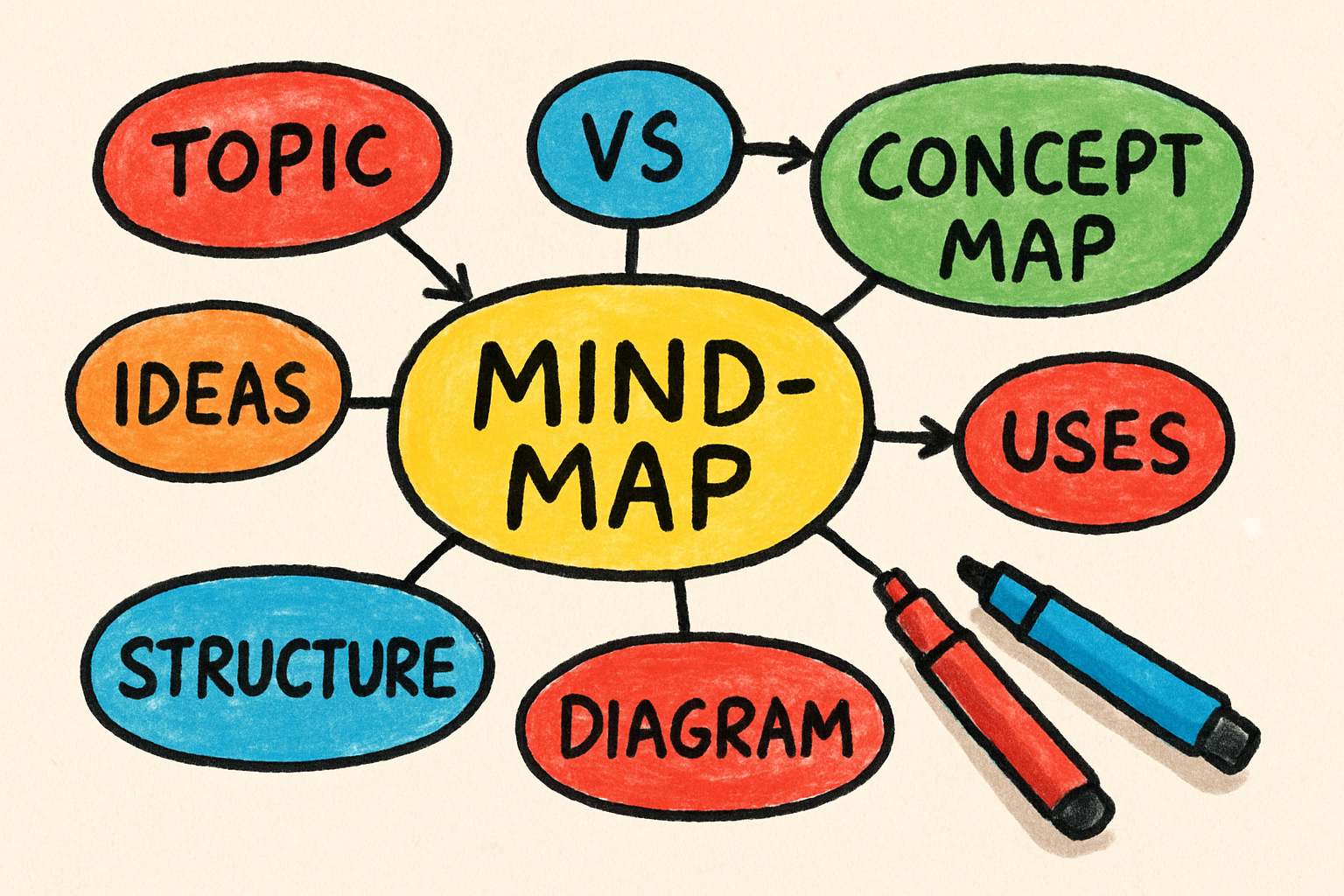
Mind Maps and Concept Maps are powerful visual tools for organizing and presenting information. Despite their similarities, they differ significantly in structure and application. While Mind Maps have a hierarchical and creative structure ideal for generating new ideas, Concept Maps are more interconnected and focus on illustrating the relationships between different concepts. Choosing the right tool heavily depends on the specific objective: Mind Maps are excellent for creative brainstorming sessions, while Concept Maps are ideal for complex, scientific analyses.
What is the Difference Between a Mind Map and a Concept Map?
Mind Maps and Concept Maps both aim to visually structure information but differ greatly in structure and function. A Mind Map typically starts with a central theme and expands in a tree-like structure. This method is excellent for brainstorming and creative processes as it encourages associative thinking. Common mistakes when creating Mind Maps include making them too detailed or cluttered. A tip is to focus initially on the main topics and then gradually add details.
Concept Maps, on the other hand, consist of multiple concepts connected by links and labels. They are ideal for clarifying complex relationships and hierarchies. A common misconception is to view Concept Maps as simple diagrams, although they offer much more. They help identify deeper connections and present knowledge in a structured way, making them particularly valuable in the education and scientific sectors.
When is a Mind Map Suitable?
Mind Maps are particularly useful for generating new ideas or supporting creative processes. They are ideal for:
- Brainstorming Sessions: Here, all ideas can be collected without immediately imposing a structure. The freedom to link thoughts associatively can lead to innovative solutions.
- Project Planning: A Mind Map can help capture all possible aspects and ideas without being confined to a specific structure from the outset. This is especially helpful in the early stages of a project.
- Structuring Thoughts: Whether preparing a presentation or writing an article, Mind Maps provide an overview of all relevant points and their connections.
- Creating Presentations: The overview of the entire presentation and the ability to remain flexible helps maintain the narrative thread.
For example, when planning a new project, a Mind Map can help capture all possible aspects and ideas without being confined to a specific structure from the outset. The AI-MindMap by timeghost offers a quick and efficient way to create and expand Mind Maps with its AI-powered features. Automating routine tasks saves time and resources, allowing users to focus on the essentials.
When is a Concept Map Suitable?
Concept Maps are ideal for illustrating complex information and their relationships. They are suitable for:
- Scientific Analyses: In research, Concept Maps can help illustrate theoretical concepts and their relationships, making it easier to understand complex theories.
- Presenting Learning Content: Teachers can use Concept Maps to clarify the relationships between different concepts for learners, facilitating and deepening learning.
- Clarifying Complex Relationships: In companies, Concept Maps can be used to visualize processes or systems, enhancing communication and understanding.
- Documenting Knowledge Structures: They are useful for documenting and sharing knowledge, especially in larger organizations where knowledge transfer is important.
For example, a biology teacher might use a Concept Map to visualize the relationships between various biological concepts such as cell structure, DNA, and protein synthesis. Here, a Concept Map can serve as an interactive learning aid that helps students better understand complex relationships.
Comparison Table: Mind Map vs. Concept Map
| Criterion | Mind Map | Concept Map |
|---|---|---|
| Structure | Hierarchical, tree-like | Interconnected, with links between nodes |
| Main Goal | Creative brainstorming | Analysis of relationships and structures |
| Application Examples | Project planning, creative work | Scientific analyses, knowledge presentation |
| Flexibility | Very flexible, associative | Structured, focused on connections |
This table illustrates the key differences and applications of the two mapping tools. It serves as a practical decision aid when choosing the appropriate tool for your specific needs.
How Does AI-MindMap by timeghost Support Both Approaches?
The AI-MindMap by timeghost enables the creation of both Mind Maps and Concept Maps directly in Microsoft 365 and Microsoft Teams. With the help of AI, complete Mind Maps can be generated and expanded from a description. This functionality is particularly valuable when time is short and quick results are needed. Through seamless integration with tools like Jira, GitHub, and Microsoft Planner, AI-MindMap provides comprehensive support for project management and collaboration. The integrations ensure that information is not isolated but can be used in existing workflows.
Practical Application of Mind Maps in the Workplace
In the workplace, Mind Maps can help make meetings more efficient. A well-prepared Meeting Agenda Mind Map not only structures the process but also helps keep all relevant points in view. The real-time collaboration features of AI-MindMap allow teams to work together on the Mind Map, increasing efficiency and clarity in meetings. With live cursor and comment functions, all team members can make changes and provide feedback simultaneously.
Practical Application of Concept Maps in Education
In education, Concept Maps are a valuable tool for conveying complex learning content. Teachers and lecturers can use Concept Maps to clarify the relationships between different concepts for learners. This promotes a deeper understanding and helps learners process and retain information better. For example, a Concept Map can be used in history lessons to illustrate the causes and consequences of historical events, deepening students' understanding of the complexity of history.
Conclusion: When is Which Tool the Right Choice?
Mind Maps and Concept Maps are powerful tools that offer different advantages depending on the objective. Mind Maps are ideal for creative processes, while Concept Maps are best suited for illustrating complex relationships. The AI-MindMap by timeghost offers an excellent platform to efficiently and collaboratively utilize both approaches. Take advantage of the opportunity to test AI-MindMap for free in Microsoft Teams and experience the benefits for yourself. Whether you are a project manager, a knowledge worker, or a teacher, AI-MindMap can significantly ease your work and increase your productivity.
Sources and Further Reading
- "Mind-Map vs. Concept Map: A Comparative Analysis"
- "The Theory Underlying Concept Maps and How to Construct and Use Them"
- "Tony Buzan: The Man Behind the Mind Map"
- "ISO/IEC 27001:2013 Information security management"
This article is for general information purposes. The content was created with AI assistance and editorially reviewed. Date: 2026-08-11.
Frequently asked questions
What is a Mind Map?
A Mind Map is a visual tool that organizes information hierarchically. It starts with a central theme and branches into subtopics. Ideal for brainstorming and creative processes.
How does a Concept Map differ from a Mind Map?
A Concept Map shows relationships between concepts in a network. Unlike the hierarchical structure of a Mind Map, it is more interconnected and suitable for complex analyses.
When should I use a Mind Map?
Use a Mind Map when you want to generate ideas or creatively structure information. It is particularly useful for brainstorming sessions and creative projects.
What are the benefits of a Concept Map?
A Concept Map helps visualize complex information and their relationships. It is excellent for scientific analyses and understanding complex topics.
Can I combine Mind Maps and Concept Maps?
Yes, combining both methods can be beneficial. Use Mind Maps for creative ideation and Concept Maps to analyze relationships between these ideas.
About the Author

timeghost Team
Editorial Team
The timeghost team builds AI-MindMap and writes about mind mapping, AI-assisted collaboration and productivity in Microsoft 365.
Share article